Webb pinpoints farthest fast radio burst’s tiny host galaxy
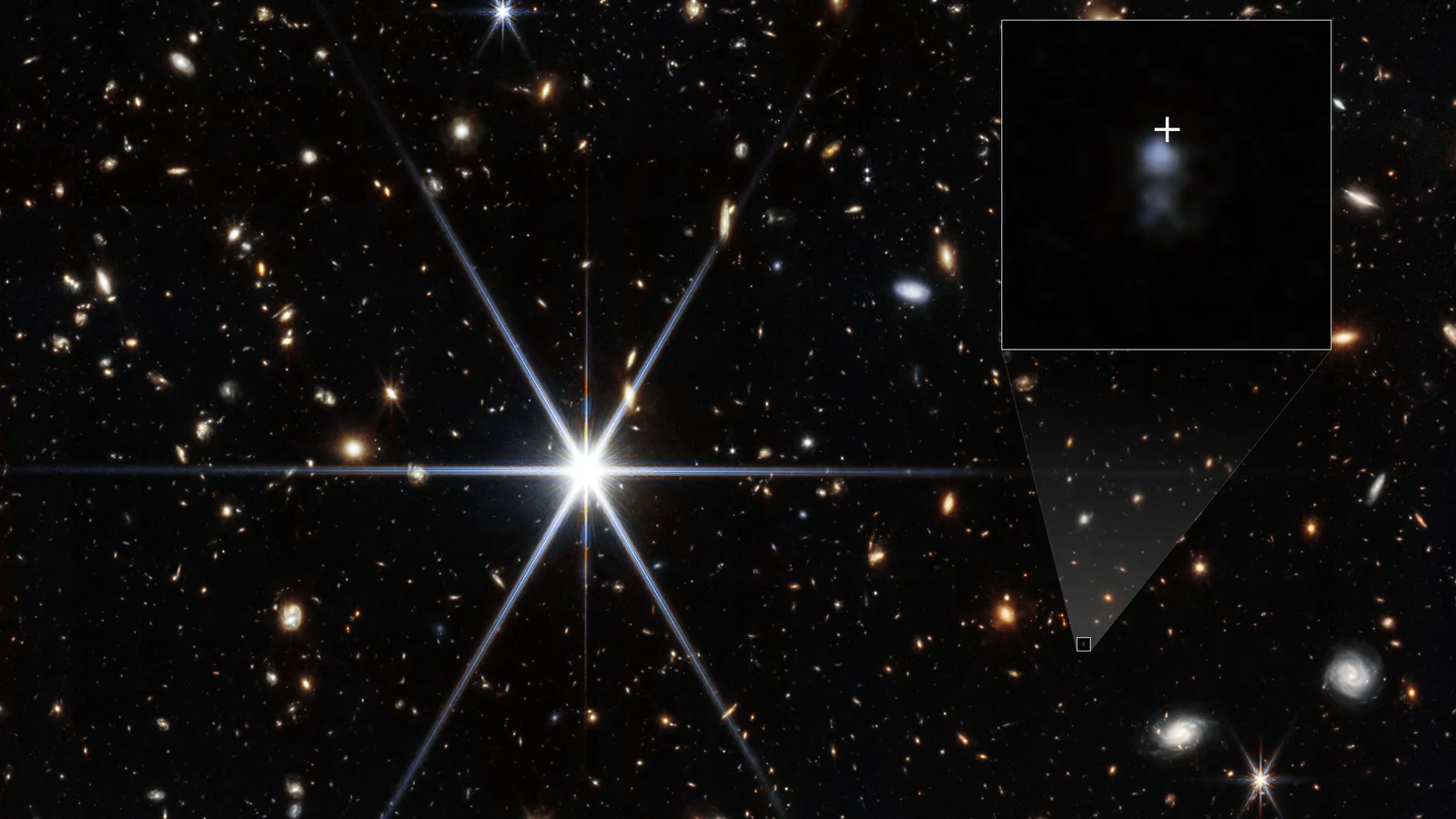
A radio flash lasting only milliseconds has been traced to a tiny galaxy from an era when the universe was about 3 billion years old. Observations with the James Webb Space Telescope place FRB 20240304B farther back in cosmic history than any other fast radio burst identified so far. Its star-forming home offers a clue to what produced it.
The study, led by Manisha Caleb of the University of Sydney, was published in Science on October 8. The MeerTRAP team detected the pulse with South Africa’s MeerKAT radio telescope on March 4, 2024, and first shared the research as a preprint in August 2025.
Radio observations pinpointed the burst’s position on the sky, but ground-based telescopes could not find a galaxy there. Webb’s Near-Infrared Camera picked it out, and its Near-Infrared Spectrograph measured a redshift of 2.148. Redshift records how much the universe’s expansion has stretched light, allowing astronomers to place the galaxy in cosmic history.
The small galaxy is actively forming stars. That environment favors a young magnetar—a neutron star with an exceptionally strong magnetic field—as the source, the researchers say. A scenario involving two neutron stars spiraling together over billions of years fits less readily with a young stellar population. The object that emitted this particular pulse has yet to be identified.
Distant bursts also carry information about the material their radio signals cross on the way to Earth. The paper describes how FRB 20240304B probes ionized, or electrically charged, gas across much of cosmic history, helping astronomers examine matter between galaxies.
Ryan Shannon, a Swinburne University astrophysicist who was not involved in the study, told ABC that such signals offer a way to study the cosmic web, the large-scale network of matter in the universe. He said fast radio bursts may have more than one kind of source.
Sources
- SciencePrimary source
- ESA/WebbPrimary source
- NASAPrimary source
- ABC ScienceSecondary
Comments
No comments yet. Be the first.